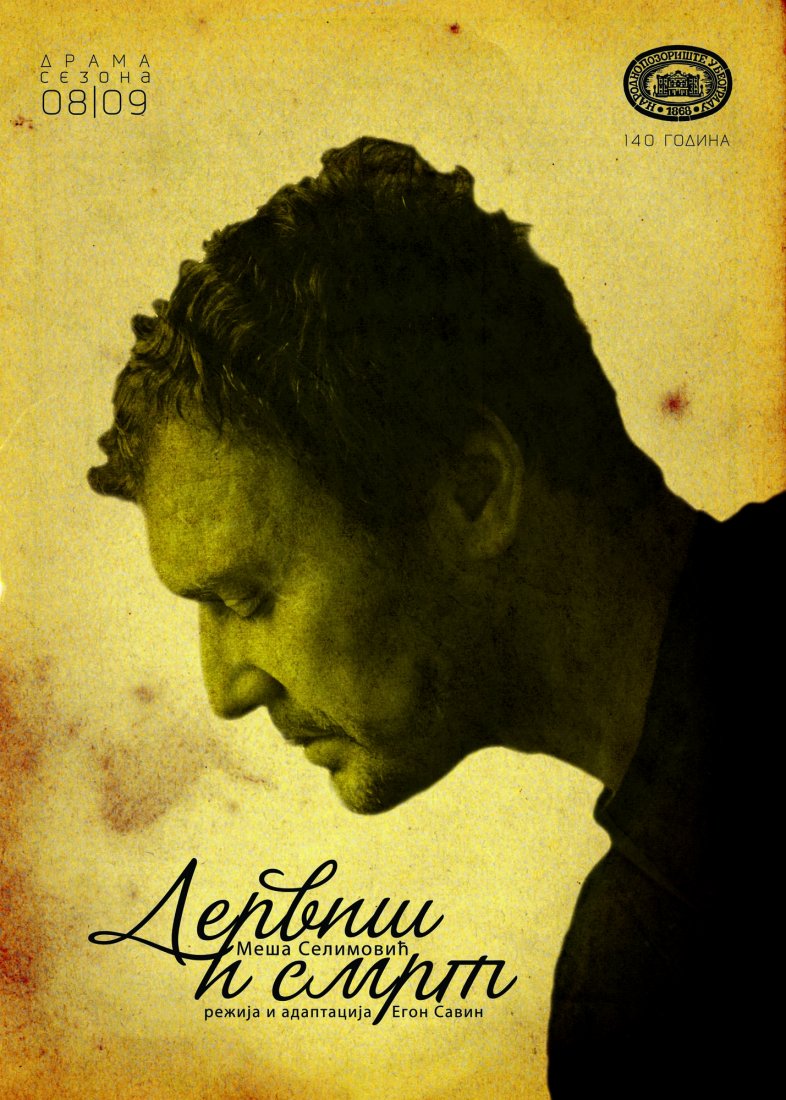
DERVISH AND A POET
In the midst of a picturesque and mythical milieu, concrete and symbolic, in the middle of this seemingly rationally organised imperial province and events provided with ideological, moral and psychological motivation, in the background or depth, you can feel intensive presence of a blurred essence, difficult to explain, from which the existence is separated. We are reached by hollow voices of a world which humanity hardly has the insight into. Presence of some irrational instigators and layers becomes more and more obvious. The power of words and understanding is weakened under the terror, violence, under the burst of bestiality and indifference which nature intercepts man with. Here where everything is wavering, the border between good and evil, deception and reality, truth and lie, language and matter, conscience and world, is also wavering. Prolonged into a typical oriental meditation and metaphysics, above which the spirit and the word of the Kurgan and Islamic philosophical tradition float, the world of certainty and law is disintegrating thanks to one real being filled with anxiety and fear, to be exposed as the reality of a nightmare, fate, coincidence. The world condensed into the metaphor of “running away and pursuing”, into the image of a dungeon whose foundations are cosmic and historical, could not motivate Ahmed Nurudin to believe in reason, but on the contrary, the suspicion that he himself was handed over into the hands of irrational, demonic powers which handle man and his destiny. The air of this great perplexity and inquiry are being breathed by all characters of Selimovic’s novel. While they talk, we have an inkling of what they are silent about. This procedure of leaving out, conveying through well-composed blanks is characteristic of Mesa Selimovic’s style and way of thinking. Mesa made a present of his contemplative temperament and his inclination towards philosophical to Ahmed Nurudin, placing him in the life circumstances which make such a man and such a contemplation feasible. Action and contemplation are permeated like literariness and viability, modelling that inner voice which is speaking. This dedication with which one talks cannot be brought down to the literalness. Dervish is guilty in his own eyes and he might become a hero, a traitor who might redeem himself, a judge who is his own judge and a witness, “a soul who scolds himself in a voice” intimate but not private, with irrelevant proportion of self-pity and intellectual affectation, in a refined but not lifeless voice, succulently but also subtly, with lucidity and experience, with restraint and at the same time with enthusiasm and elation, gentlemanly but not formally nor dreary. Death and the Dervish is a book of maturity, and the strength and force of its wisdom does not lie in the philosophical uniqueness of Nurudin’s deliberations, but in the poetic worthiness of the language, tone, suitable to the “mode of being” and its environment. What this book impresses by is not some isolated spectacular intelligence, but the sensibility and imagination of a poet on which this tragic vision of life leans on. Individual and solemn tone conquers, balanced and frenetic at the same time, the tone of a man who thinks about himself maturely and with profound.
From: Muharem Pervic Dervish and a poet (Selection of critical texts about Death and the Dervish in Miroslav Egeric “Death and the Dervish” by M.Selimovic Zavod za udzbenike i nastavna sredstva, Belgrade, 1995
THE WORD OF A DRAMATURGE
For two decades Mesa Selimovic had been carrying deep inside the sorrow for the lost brother, before he turned it into the story about Ahmed Nurudin, dervish who, from the world of dogmatic principles enters into a changeable, unknown world in order to find out the truth about his arrested brother. Discovering repressive methods thanks to which the state authority operates, Nurudin gradually loses self-respect, and the pain for losing his brother is replaced with hatred and the wish for revenge. More than once, answering questions, Mesa Selimovic mentioned that hatred, envy, love and passion in general greatly influence man’s actions on conscious or unconscious level and that denying of all man’s currents – is denying of life itself. In his book about Selimovic’s novel, Miroslav Egeric notices that if something is of no use for value and richness of life of an idividual, it is of no use for life itself. Seeing the complexity of Nurudin’s character, we can only assume the drama that was going on inside the writer, while trying to understand the act of killing his innocent brother, but also to explain his own silence for such a long time. The performance adapted and directed by Egon Savin, points to the reasons for keeping silent, which was just a part of the deafening silence in the period when it was impossible to speak without consequences. The story was moved from the 18th century into the fifties of the last century, in post-war Sarajevo and new state. In a political system in which people sing about construction and freedom, one word can cost you your life, the moral responsibility of any individual, even dervish’s, can not been seen out of the context of power and state. Unfortunately, regardless of efforts and laws to protect rights and life of individuals in a modern world, we are the witnesses of the fact that Ahmed Nurudin could walk through our time, and would surely run into a close door, people who refuse to give answers, to dead silence and sneer, and he could even loose his life because of the spoken words. Thomas. J. Butler, in a text Literary stile and poetic function in the novel Death and the Dervish says: ”Dervish, at the deepest level, could represent a new myth of today’s life. According to this myth, eternal struggles, ideological frictions, nationalism and rage for power, destroy the structure of mankind to such an extent that people have lost the will for life, lost faith in each other. A man, who is being manipulated for political aims, in today’s time, feels the atrophy of natural instincts and dying out of the basic human emotions.” The only thing we do not know is whether Ahmed Nurudin would, in a moment of doubt, the last sentence “For death is senseless as is life”, say out loud or keep his mouth shut.
Branislava Ilić