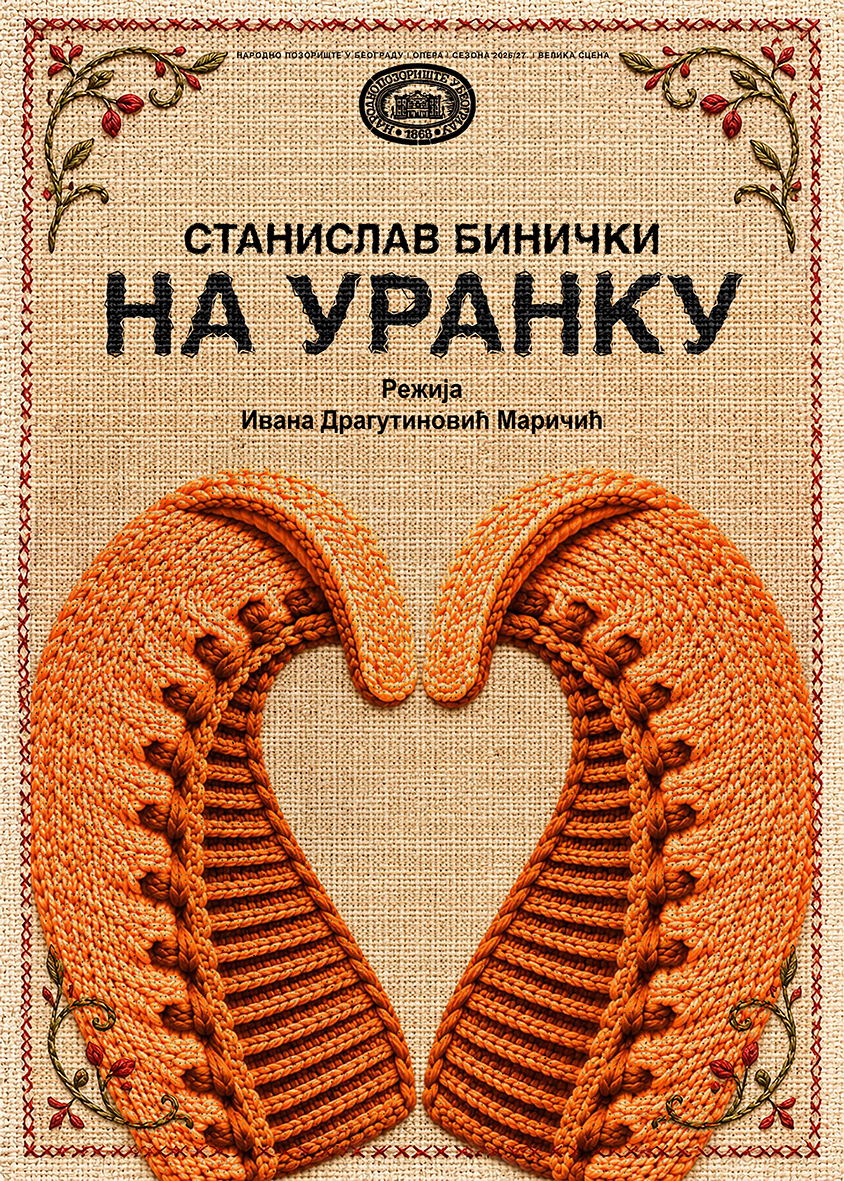
About the Opera “At Dawn” by Stanislav Binički
“One autumn day in 1894, a young man arrived in Leskovac to take up a teaching position, and he quickly won everyone’s hearts with his cheerful and lively spirit. (...) His endless love of song, his vibrant temperament, his organisational skills and, above all, his ability to bring out even the most hidden talents in his young and inexperienced singers and instil in them a belief in success, soon led the ensemble to remarkable growth and unexpected success.” This recollection of the young Stanislav Binički, dating from the time when he led the choir of the “Branko” Leskovac Singing Society, was recorded by Mirko M. Popović in 1924 and it paints a portrait of an artist who would go on to establish in Belgrade the first symphony orchestra in 1899 (today the “Stanislav Binički” Artistic Ensemble of the Ministry of Defence); in the same year, he founded the first music school, together with Mokranjac and Manojlović; and subsequently the Opera of the National Theatre in Belgrade (1919), of which he was also the first director. Above all, however, he would be remembered as the composer of the first Serbian opera, At Dawn (1903). It was no coincidence that Branislav Nušić observed that Binički’s arrival in Belgrade in 1899 marked the beginning of a new era in the musical life of the capital.
Stanislav Binički (1872–1942) was born in the village of Jasika, near Kruševac, where his father, Stevan Binički, an engineering officer, was stationed. While his mother, Baroness Marija von Rechingen, encouraged him to pursue music, his father steered him towards technical studies. From an early age, he learned to play the violin and flute, composed music, sang in a church choir and later also conducted one. At his father’s wish, Binički enrolled in technical studies in Belgrade, but also became a member of the Belgrade Singing Society, conducted by Mokranjac, and the “Obilić” Academic Singing Society, under the direction of Josif Marinković. Mokranjac, Marinković and Josif Svoboda would become his teachers.
After completing his technical studies, Binički received a scholarship to study music in Munich, where he went in 1895. He studied composition under internationally renowned Professor Josef Rheinberger (1831–1901), a composer and organist whose students included Engelbert Humperdinck, Ermanno Wolf-Ferrari, Wilhelm Furtwängler and Stevan Mokranjac, among others. He also studied solo singing, as Nušić records, not with the intention of becoming a singer himself, but so that he could teach others and, as an opera conductor, “conduct the work with understanding”. This suggests that Binički already had a vision at that time of developing opera in Belgrade. While in Munich, he married a fellow Academy student, opera singer Frieda Blank, who would become his important collaborator in the adventure that awaited them upon their return to Belgrade.
At the time of Binički’s return from Munich in 1899, the repertoire of the National Theatre in Belgrade, ever since the establishment of its music department in 1882, had included plays with songs, as well as comic operas and operettas by Vilém Blodek, Hugo Doubek, Robert Planquette, Florimond Hervé, Franz von Suppé, Arthur Sullivan, Carl Zeller, Jacques Offenbach, Edmond Audran and others, whose works were performed by actor-singers, as there were no opera singers available. Binički thus arrived with the idea of composing an opera at a time when not a single well-known full-length opera had yet been staged at the National Theatre (it was not until 1913 that Binički himself would stage Verdi’s Il Trovatore). The composer was inspired by the short story “Sally Pich”, from the collection Ramadan Evenings, written by his friend Branislav Nušić during his diplomatic service in Southern Serbia and Macedonia. The collection is said to evoke the atmosphere of the tales from One Thousand and One Nights. With considerable effort, Binički managed to persuade Nušić to write an original libretto, which, according to many, possesses the universal dimension of classical drama. This suggests that Nušić approached the task of writing the opera with great care, drawing on the very roots from which the art of opera originated. The story is set in a Serbian village under Ottoman rule and unfolds on St George’s Day, from dawn until evening. The focus is on the love story of two young people, Stanka and Rade. Their happiness is thwarted by the jealous Rejep, who reveals to Rade a secret about his origins, leaving him deeply shaken, not only by the shame it brings but also by the questions it raises about his own identity. This sets in motion a dramatic turn in the libretto, culminating in the tragic death of Rade’s mother.
Binički composed his one-act opera under the influence of verismo and realism, with the elements of traditional urban Serbian music rooted in Serbian bourgeois culture. By combining Serbian folk and Oriental motifs, he created, as Roksanda Pejović observes, an atmosphere that reflected the realities of Serbia’s past. Musicologists most often compare this opera with Mascagni’s celebrated one-act opera Cavalleria rusticana, which was first performed at the National Theatre three years after the premiere of Binički’s opera in 1903. In addition to its melodic qualities, due in part to motifs inspired by Serbian folk music, the opera At Dawn also features bold harmonic solutions in key dramatic passages, particularly in its tragic finale, in a manner reminiscent of Puccini, the “master of dramatic effects”. (Immediately following the great success of Il Trovatore, Binički would stage Puccini’s Tosca, just 14 years after its world premiere.)
At the time At Dawn was staged at the National Theatre, Binički had primarily actor-singers at his disposal. Milan Grol notes that one of the requirements for admission to the theatre company was having a good voice and ear for music: “Only those with exceptionally outstanding dramatic talent managed to be admitted to the acting company without these singing abilities.” The care Binički took in selecting his singers is evident from the fact that he entrusted the role of Rade to the actor-singer Radovan Raja Pavlović, apparently a dramatic tenor, who had performed as a singer in Berlin, Dresden, Leipzig and Budapest. He assigned the role of Rejep to the renowned actor Dobrica Milutinović, a baritone role on a par with those of the great operatic villains. Milutinović, who had taken singing lessons for a time from Binički’s wife, was, in the composer’s opinion, a magnificent Rejep who captivated audiences, although, as Binički remarked, he sang “in a somewhat more sevdalinka-like style”. The role of Stanka was performed by the popular actress and singer Desanka Đorđević, whom the press praised for “singing like a nightingale”, while the role of Anđa went to Luiza Stanojević, an actress and one of the finest singers in plays with songs and operettas. In subsequent seasons, the role of Stanka was taken over by Sultana Cijukova (soprano), who had completed her solo singing studies at the Vienna Conservatory and performed at the Hamburg State Opera and the Mainz Opera, and also made guest appearances in London and Vienna. Her husband, bass singer Žarko Savić, took on the role of Rejep. He had also trained in Vienna and performed at the Kroll Opera House in Berlin, the Court Theatre in Dresden, and in Düsseldorf, Hamburg... Every appearance by these internationally acclaimed artists attracted considerable public attention.
The premiere of At Dawn took place on 20 December 1903. The production was directed by Svetislav Dinulović, with Binički himself conducting and another Munich-trained artist, painter Brana Cvetković, designing the sets. Although virtually none of the reviews have survived, Binički himself recalled that opinions were divided, while the audience was undoubtedly pleased. If the success of an opera is measured by whether its arias become popular beyond the opera stage, then Binički’s work certainly achieved that distinction. Stanka’s aria “Beyond That Mountain” and Rejep’s aria “If Only You Knew, My Darling Stana” have remained beloved traditional urban Serbian folk songs to this day.
Vanja Kosanić
Synopsis
Stanka comes to the well to fetch water, expecting to see Rade, a young man she loves. Soon after Rade arrives and the young lovers speak of their love and longing. When Anđa, Rade’s mother, appears, he asks her to bless them and she happily gives them her blessing. Rade leaves with his mother because a messenger awaits him, while Stanka stays to wait for him and pick some flowers in the meantime. Rejep has overheard their conversation and he approaches Stanka telling her he loves her and she can only belong to him. Stanka begs him to leave her alone, telling him she is in love with someone else and already betrothed. However, Rejep insists that she must be his. Stanka replies that she never will be and runs away from him.
During the orchestral interlude, the mother consecrates the house according to folk tradition, ahead of her son’s wedding.
The villagers come singing. When Rejep appears the singing ceases, but Rejep demands that they continue singing. Men and women from the village resume singing, but now they are singing a wedding song as Stanka has arrived. Hearing the song, Rejep orders them to stop singing at once if they value their lives. One of the villagers explains that they are singing that song because Stanka has been promised in marriage to Rade. Rejep addresses Stanka sneeringly telling her she should be ashamed of her engagement. She replies that she is chaste and has nothing to be ashamed of. Then Rejep announces before the villagers that Rade is a child born in sin, out of wedlock. Everybody is appalled. At that point Rade arrives and after learning what aga has said, wants to kill him for slander. However, Rade’s mother appears and prevents him from doing it. Rade tells her what the Turk has said. His mother tells him it is not true: he is not a child of sin, but a child born of love. Beside himself, Rade grabs his rifle to kill Rejep, but his mother rushes forward and gets shot instead of the Turk, sacrificing herself to save her son from being executed for murdering the Turkish aga. With her dying breath the mother asks her son for forgiveness, and the opera ends with a Muezzin’s prayer from a minaret, echoing from afar.