A Word from the Director
Bora Stanković was a chronicler of destinies - destinies that defy time and oblivion; destiny as the common denominator of all those who lived, who live now, and who will live on this earth. He recorded the lives of the beggars of Vranje, of those destitute and mad, with remarkable vividness, in a voice that defies, warns, and inspires.
The last five years in this country have been a time of madness and death. We witnessed that time, each in our own way, and we brought that testimony with us into the rehearsal room. That is why this production did not emerge merely as a story about beggars and Vranje, but as a collective conversation about fate, death, and madness - a conversation seldom held, and yet concerns us all.
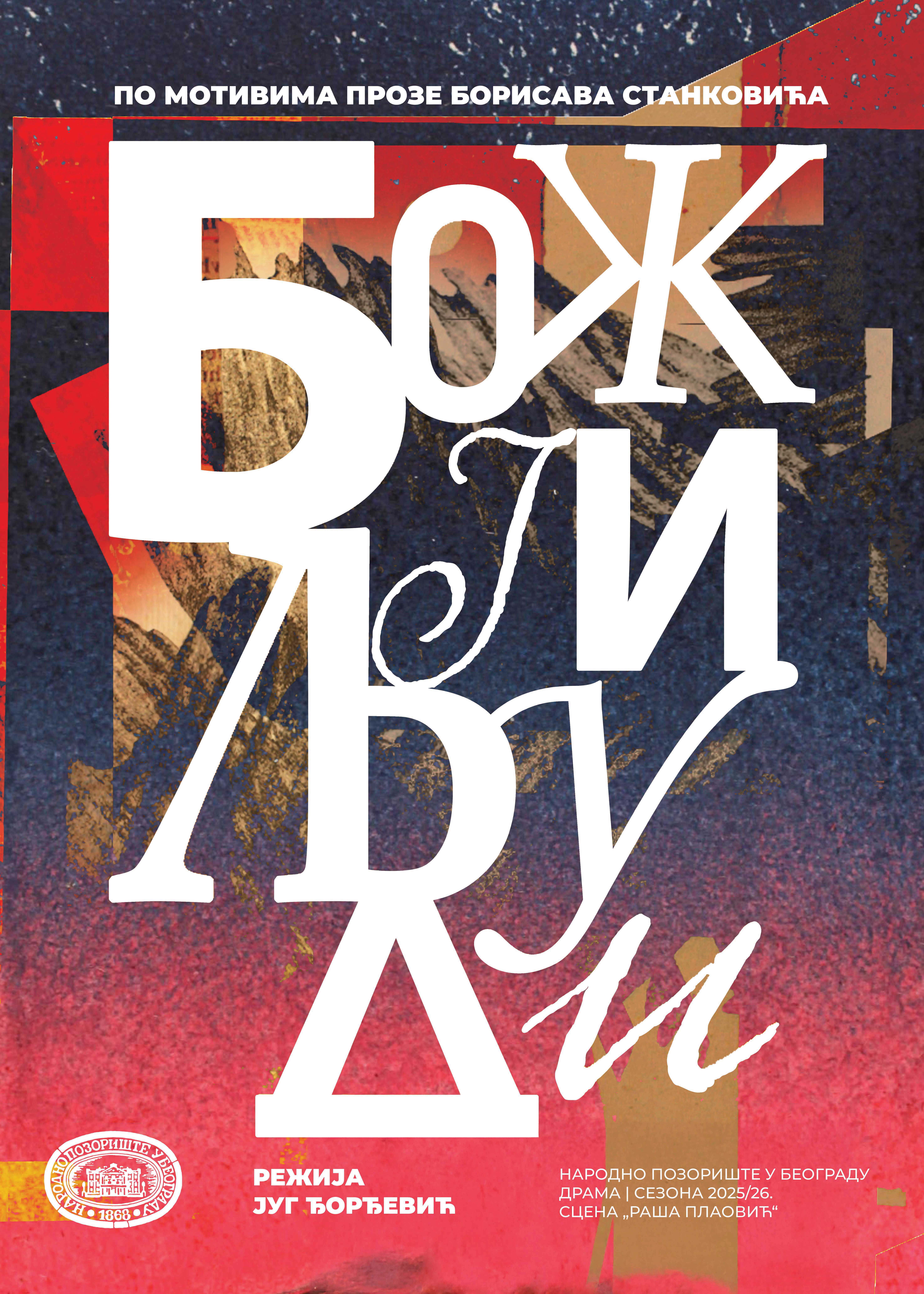
Those conversations led to the performance before you. It is a visual poem: a sequence of images, scenes, and voices arranged not according to the logic of plot, but to the logic of memory. We sought a form rooted in storytelling rather than representation.
So, we give you “God’s People”.
Jug Đorđević
A Word from the Dramaturge
When Borisav Stanković published God’s People in 1902, Serbian literature became richer for a gallery of characters unlike almost any it had known before. Beggars, the destitute, the blind, the mad, and the outcast - all those whom old Vranje looked at but did not truly see - were, for the first time, looked in the eye, with the kind of attention we usually look at saints. In a series of brief, emotionally condensed sketches, Stanković recounts the destinies of those who lived on the margins: homeless, nameless, and without a future, but not without dignity.
The title is no coincidence. In folk and Orthodox tradition, the poor, the helpless, and the mad are “God’s people” - those who belong to God, marked by His finger and sheltered by His hand. Stanković neither ironizes nor preaches this belief; he simply acknowledges it and narrates it as an example of human destiny. That is why there is no social condemnation for his beggars but rather there is a quiet wonder before the mystery of human misery, and before that dreariness, that Vranje melancholy which, in his work, is an amalgamation of both pain and bliss at the same time. In contrast to the idyllic image of village life cultivated by the realism of his time, Stanković descends deep into darkness, and within that darkness he finds beauty, longing, and death, inseparably intertwined. For this reason, God’s People is still read today as a book about what remains of a person when everything has been taken away: only a story remains.
It was from that word, from that story, that we began. This production was not conceived as a dramatization, as a translation of prose into dialogue and stage action, but as an act of storytelling. We replaced mimesis - the imitation of another’s character - with narration as a theatrical method: the actors bear witness to the characters, they carry them, and pass them on. This is not about “becoming someone else,” but “telling someone’s story,” and in doing so, preserve them from oblivion.
For storytelling and death have always been closely related: the storyteller draws their power from mortality, and every tale told is a small act of resistance against disappearance. Pondering about their own transience, the actors discovered that the boundary between the one who tells a story and the one whose story is told is not fixed; that, sooner or later, we are all God’s people.
What we offer you this evening, then, is not a portrait of other people’s lives, but an invitation to listen together, just as people once gathered around a fireplace, to summon back, if only for an instant, and keep among the living those whom the world let go long ago.
Đorđe Kosić