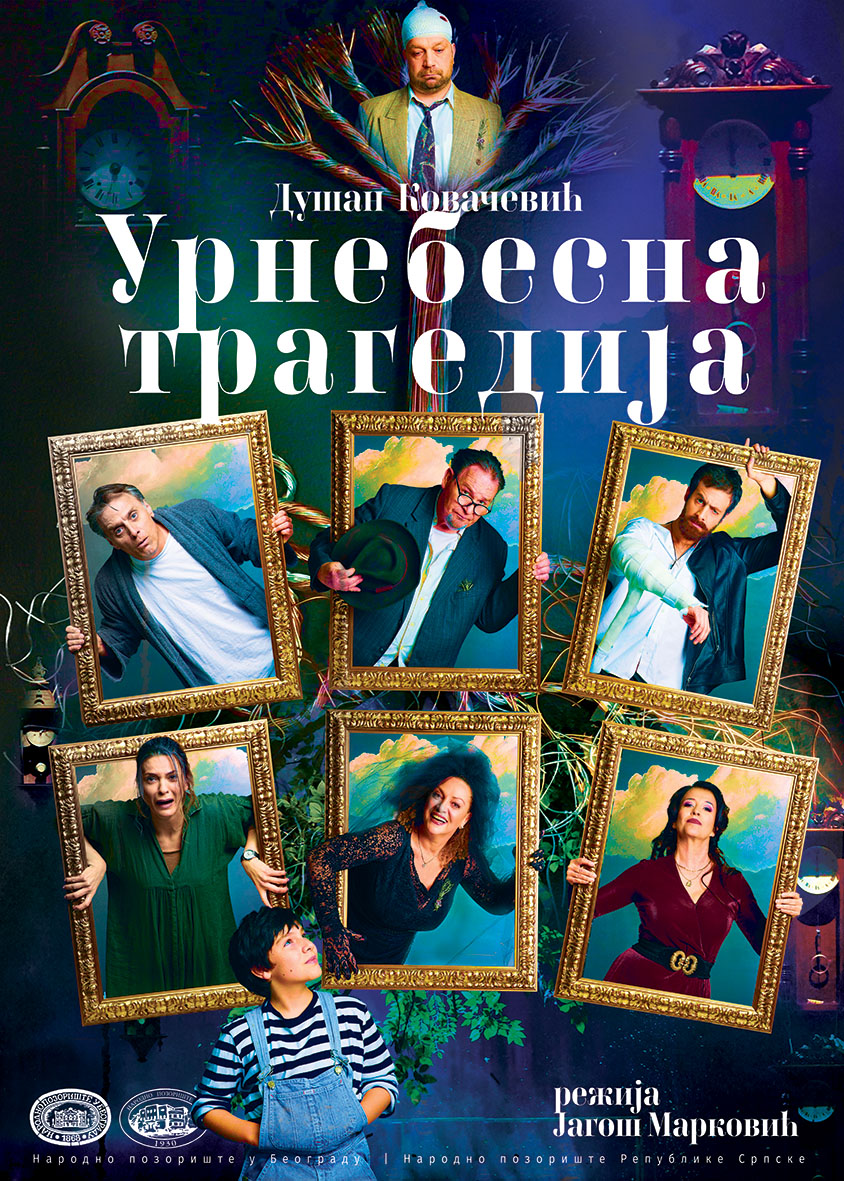
Co-production: National Theatre in Belgrade and National Theatre of the Republic of Srpska, Banja Luka
A Word from the Author:
Basically, it is still today, as it was when I wrote it, a story about the destruction within a family. There is a definition, in which I deeply believe, that the family is something that is the epicentre of our life and one of the most significant factors in our existence. Our children learn from the postulates of relationships within the family. Family is the most essential and important school in a person's life. The kind of family a person grows up in, that's the kind of person he will become. Certainly, school i.e. education, is necessary, but fundamental values such as love, kindness, and honesty are something that we learn within our family. At the time I was writing this story, the situation in the former Yugoslavia was very uncertain, and it reflected on the mental, social, and overall sense of security within family life. If you do not have a normal family life, you are a tragic person. When it comes to destruction, the play has several main lines, one of the main ones being the story of young people who lose their identity. Who are we today, after everything that has happened to us over the past three decades, since the first staging of The Tragic Burlesque in 1991? We are still searching, because of the many divisions we live in, divisions that multiply like rabbits. And instead of coming to our senses, we are losing them. Every day we hear and see opposing opinions, conflicting views. If someone says something is good, three others immediately come forward to say it is not true. That is why lately I often, somewhat cynically, repeat that if someone were to propose importing the plague into the country tomorrow, there would still be people in favour of it, because even the plague has some “good sides.” It is cynical, absurd, and ugly, but I am afraid it is partly true, because we have reached the very edge of illogic behaviour and absurdity. That is one of the lines of the play we mentioned - the search for a lost identity. Another line is the violence endured, which is reflected in the story of the brother and his sister-in-law. In the background, there is also a rather sad picture of the fate of a theatre that, due to accumulated and mostly social problems, is shutting down and turning into something that has nothing to do with art.
Dušan Kovačević
(excerpt from the interview “Instead of Coming to Our Senses, We Are Losing Them,” Mikojan Bezbradica, “Pozorišne novine”)
A Word from the Director:
The Tragic Burlesque is a classic. I really like this play; it is dense. Duško has “tailored” something I have not encountered anywhere else - he has combined the hilarious and the tragic. I am so impressed by this fusion of the hilarious and the tragic that I do not feel familiar and relaxed with this material; rather, I feel strongly inclined to respond to the work. And what is both hilarious and tragic in this play? Everything. Nothing less than everything. There is abundance, both in themes and in recognition.
The focus of the play is the family, because it is a microcosm. You can find there both society and the individual, all generations and all times. Everything is reflected through it. Everyone lives their own reality. Everyone even chooses it. That does not mean that there is more than one truth. However, the experiences are many.
Everyone builds their own identity; that is where you are on your own. I always fight for that part of freedom and space, where I am personally responsible. We should try to place at the center not some abstract society, but ourselves, our own selves, our being and our humanity and our distance from humanity. Perhaps then both we and that society I am interested in might become better, since I see it almost as a ruin of all values, and I have been seeing it like that for a long time now. We are worse and more unhinged, dramatically so. But we have survived since long ago, and it seems we will survive in the future, forever… We have mutated, grown numb, and become accustomed. We have adapted.
What is fascinating about us is that we always find a way out and survive. We are very resilient. I respect that.
That laughter in The Tragic Burlesque is miraculous… In laughter there is rebellion, in laughter there is freedom, in laughter there is comfort, in laughter there is resistance, in laughter there is revolt. And a path… That kind of healing power that good comedy provides can never be matched by anyone and anything. It’s been many years since I have done comedy - if this is a comedy at all, and it is, because of the first part of the title and its theme. And I greatly enjoy it. I can hardly wait to share it with the audience. This is what we truly need.
Jagoš Marković